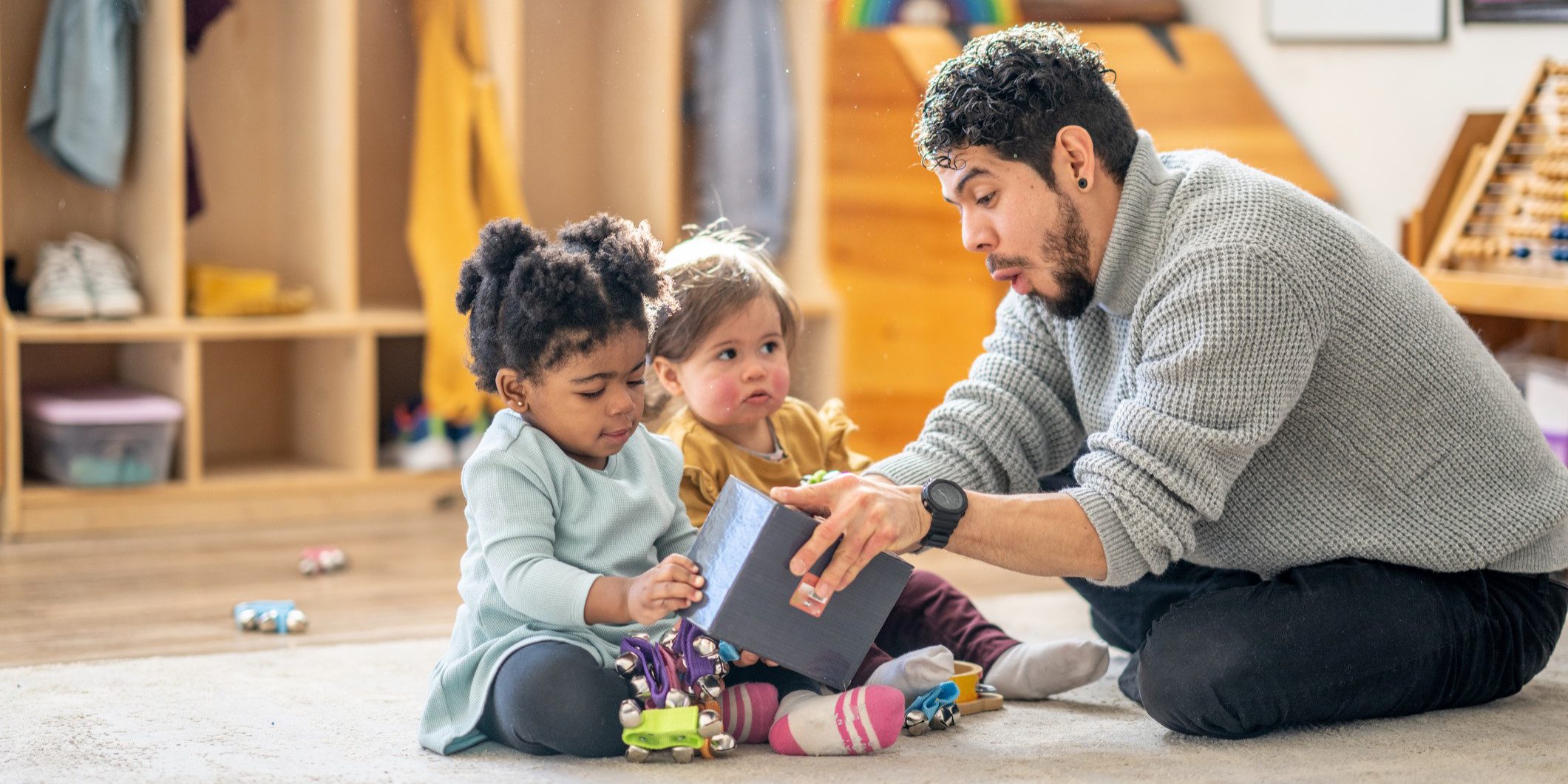
This measure analyzes how the teacher models making complete, correct sentences from the children’s fragmented comments or grammatically incorrect sentences. The teacher must do more than correct a mispronounced word. For example, if an infant reaches for the ball and says, “Ba,” the teacher should ask, “You want your ball?” and not say, “Here you go.” Or, if a child says, “I ain’t got any more clay,” the teacher should respond with, “You don’t have any more clay. Here’s some more.”
Category: Category 2: Teacher-Child Interactions
Subcategory: Language Facilitation and Support
Examples
In this section you will find videos, images, and/or documents that can be used to better understand this measure. These examples can also be used in conversations between mentors, directors, and/or teachers to discuss how the program's current practices compare to these examples.
Video Example
In this video exemplar, the teacher noticed a child’s verbal attempt to communicate and then extended the toddler’s language. Teachers can deepen or expand on children’s initiation by providing more specific information or building on a child’s background knowledge.
Age(s): Toddler
Guide
This document contains many examples of how to model correct speech and/or language. Modeling and recasting help children learn the rules of how speech and language work.
Age(s): Infant, Toddler, Preschool, School-age
Video Example
This teacher models complex language throughout the video. When the child says, “It makes me happy,” the teacher recasts by saying, “It makes you happy? Erin said it makes her happy.” Recasting children’s responses shows them you are excited about what they have to say and provides a model for correct and complete language.
Age(s): Preschool
Video Example
The caregiver in this video consistently builds on children’s responses by modeling correct and complete language. At 0:48, when the child says the giraffe is “sitting,” the teacher extends his response (“He’s sitting on my chair.”). Extending and modeling language supports children’s language development.
Age(s): Toddler